Skip to content

Meet Jerry White, Atari’s Mr. BASIC

⏬ Scroll down for 21st-century BONUS CONTENT including podcast interviews with Jerry White ⏬

(PAC Ed. Note: This article is from the Jersey Atari Computer Group Newsletter, May 1984.) 

It is nearly impossible to pick up any journal containing material for the Atari computing system which somewhere does not mention the name of Jerry White. He either is being quoted, praised, or more likely, the author of the piece you are reading. Mr. White has to be one of the most prolific writers of articles and programs for the Atari computer. His credits now include The Atari User’s Encyclopedia, a reference destined to become a standard on every Atarian’s bookshelf. 

The list of commercial software credited to Jerry White literally fills a single page. At this writing they number twenty-five and many are available for both the Atari and the (horrors!) Commodore 64. Perhaps first famous for his many utility programs Jerry expanded his horizons by turning to the challenge of business, game, and educational software. That his efforts were successful is reflected in the list of manufacturers who wisely elected to publish his works. They include Adventure International, Artworx, Atari Program Exchange, C.E. Software, DynaComp, Educational Software, MMG Micro Software, Program Design Incorporated, Quality Software, Swifty, and Tronix. 

Collage of vintage software company logos, including Adventure International, Tronix, Dynacomp, Educational Software, PDI, Swifty Software, MMG Micro Software, Quality Software, and Artworx.

The thirty-seven year old White began his computing career at age eighteen as a computer operator trainee. Working mostly with business systems which had “too many problems” he quickly learned to program on the fly. In his spare time he got into utility type programs which would make his job easier during the day; things like tape library control and forms usage. This basic training would lead to a wealth of business and utility programs early in his gone-public career. 
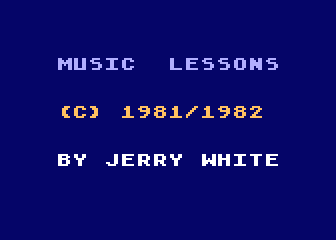
Blue screen with the following words: Music Lessons (c) 1981/1982 By Jerry WhiteHis evenings found him banging out programs on a TRS-80 but he felt very constrained by the sound and graphics limitations of the machine. When the Atari 800 made its debut he knew it was the beginning of a long time love affair. Having a background in piano it was inevitable that his mind would turn to creating great and seemingly impossible sounds from the Atari. His Player Piano, Music Box, Tricky Tutorial#6–Sound, and Music Lessons, are some of the by-products of this interest. The music for My First Alphabet added greatly to its impact and winning of Atari’s First Star Award. It also spawned a friendship which has led to Jerry joining Fernando Herrara at First Star Software since the first of this year. 

His interest in the sounds capability of our favorite machine generated delights like Talking Poker, S.A.M., Talking Chatterbee, and numerous magazine articles. The idea of using distortion 12 in the sound statement to give us a robust bass sound demonstrated in his Theme From Barney Miller has opened up the spectrum of usable frequencies available to all of us. 

One of his lesser known efforts is the marriage of the disk drive with the cassette player in a children’s educational program, Robin’s Halloween. Unlike earlier attempts such as Moonbase I/O, and Sammy the Sea Serpent,RH successfully merges the potential of computer+cassette sounds to produce a delightfully entertaining learning experience for little folks just learning to read. Actually a two part program, RH first tells an interactive story. Using a joystick the youngster has to help Robin enter a spooky castle on All Soul’s Eve to regain a power crystal stolen by an evil bat. The crystal powers a flying saucer of a friendly alien who cannot leave earth until the crystal is recovered. The story progresses only when the correct word is selected from a choice of three. The pictures and animation are great — and the little ones really get into helping Robin help the space visitor. 

Part two of the program, Robin and the Missing Letters, has the child fill in letters that are missing from a series of words. The words can come from a file on the disk or you can create a custom file of your own. Kids really like to help Robin solve the word problems. If you have a youngster just beginning to put words together this program is a fun way to encourage learning. As if these credentials weren’t enough the energy of Jerry White is channeled into regular contributions to magazines like Antic, Compute!, ANALOG, and many others. He is the founding President of the Professional Atari Programmer’s Information Exchange. He is available on CompuServe’s AtariSIG as 71415,1420. 

Those of you wise enough to have bought some of Jerry White’s programs know that they are people-sensitive. He always fills his screens with prompts so the user never feels lost. The programs are logical, bug-free, and very good. He feels strongly that BASIC is too often demeaned and has proven himself the champion of the language. If it can be done in BASIC, Jerry White will do it. 🕹️

BONUS: JERRY WHITE INTERVIEWS

PHOTO CREDITS:
  • Logos retrieved from random websites, manuals, and screenshots. Used under Fair Use for educational and historical reference. 
DISCLOSURE OF MATERIAL CONNECTION:
Some of the links in the post above are “affiliate links.” This means if you click on the link and purchase the item, I will receive an affiliate commission. Regardless, I only recommend products or services I use personally and believe will add value to my readers. I am disclosing this in accordance with the Federal Trade Commission’s 16 CFR, Part 255: “Guides Concerning the Use of Endorsements and Testimonials in Advertising.”